
White Label Brokerage Solutions
Launch a White Label Brokerage Under Your Own Brand
The Altrogi Suite is the full technology stack of a forex, CFD, and multi-asset brokerage — trading terminal, client portal, CRM back office, and multi-brand control — delivered under your brand and live in as little as 48 hours.
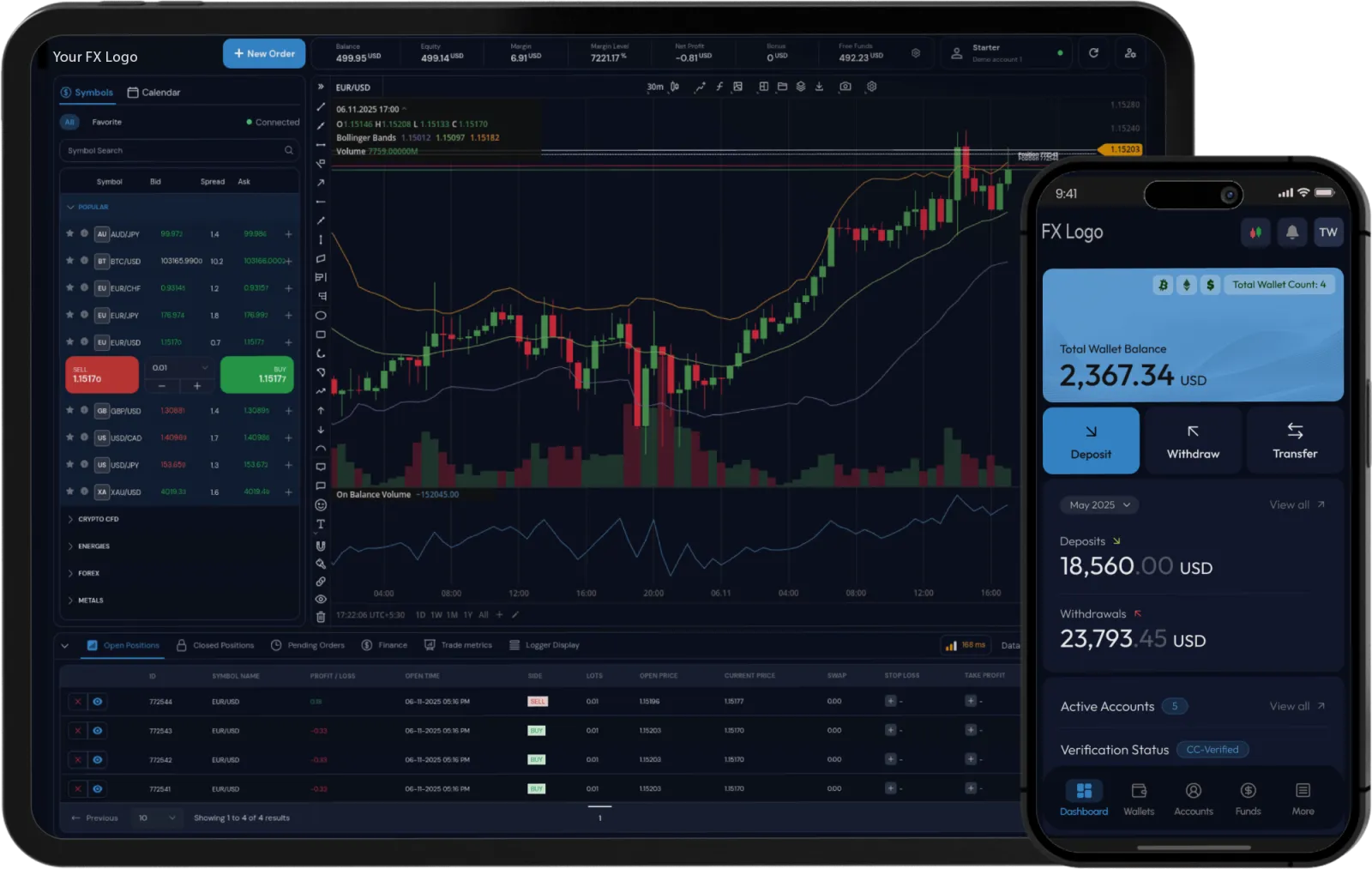
Start With the Definition
A brand on the outside. A finished platform underneath.
A white label brokerage is a brokerage that runs on licensed technology and operates under its own name. Your clients see your brand, your domain, your colors, and your account types. Underneath, a platform provider supplies what would otherwise take a development team years to build: the trading terminal, the client portal, the payments and KYC flows, and the back office your team runs the business from.
The division of labor is the whole point. You bring the brand, the corporate and licensing setup, the market access, and the marketing. The platform brings the technology — built, hosted, and maintained — so that launching a forex, CFD, or multi-asset brokerage becomes a configuration project instead of an engineering one.
In 2026 that trade is the route many new brokers take, and increasingly the way established ones add brands. For them, the real question is no longer whether to white-label — it is whether the stack you license is actually complete, or a terminal with a to-do list of vendors attached.
The division of labor
- Brand, domain & identityYou
- Licensing & legal setupYou
- Marketing & client relationshipsYou
- Terminal, portal & CRMAltrogi
- Payments, KYC & IB toolingAltrogi
- Hosting, updates & new modulesAltrogi
What a White Label Brokerage Includes
Every part of the brokerage, mapped to the product that covers it.
A brokerage is more than a terminal. These are the six things every operator ends up needing — and where each one lives in the Altrogi Suite.
A trading terminal clients open in seconds
AltTrade is a browser-based terminal, installable as a PWA — no download between a new client and their first trade. Pro-level charting, one-click execution, copy trading with allocation models, stop-loss protection, and auto profit-share, plus built-in algorithmic bots: Grid, Martingale, and Reverse Martingale.
Explore the AltTrade trading terminalA client portal that handles money and identity
AltCore is the trader’s room: multi-wallets across fiat and crypto, 9+ payment rails, built-in KYC with switchable providers, and a real-time dashboard. Deposits, withdrawals, and onboarding run under your brand from day one.
See the AltCore client portalA back office your team runs the business from
AltCRM is the broker back office: a live sales floor, lead funnels with scoring and auto-assign, maker-checker financial approvals, risk surveillance, 14+ built-in reports, and audit trails on the actions that matter.
Tour the AltCRM back officeA control center for brands and security
AltOps runs every brand from one install — runtime theming and a portal designer, guided tenant provisioning, per-brand feature toggles, MFA, and encrypted integration credentials. Rebranding happens at runtime, not in a redeploy.
See AltOps multi-brand controlRevenue beyond the spread
Growth & Revenue adds built-in casino games, a live sportsbook, and managed investments as per-brand toggles — extra revenue per client on the same platform, the same wallet, and the same back office, switched on only where you want them.
Explore Growth & Revenue verticalsAn IB & partner program
Introducing brokers are one of the main ways brokerages grow. The suite ships a partner program with multi-tier commissions, shareable invite links, and scheduled payouts — with IB reporting in the same back office your team already uses.
See the partner & growth toolsLaunch Timeline
Live in as little as 48 hours — in four steps.
In 2026 a brokerage launch should not be an engineering project. The platform side of an Altrogi launch is a short, guided sequence.
Book a demo
Walk through the suite live with our team and map it to your business — asset classes, account types, target markets, and which trading platforms you want to offer.
Configure your platform
Set up branding through the portal designer, define account types, and configure your payment methods and KYC stages. This is configuration, not custom development.
Connect your services
Connect your trading platform — MT5, Match-Trader, or the native engine — along with your payment providers and KYC provider, with credentials encrypted in AltOps.
Go live
Start onboarding clients, processing deposits, and running your sales floor. From here the timeline is a business plan, not a development roadmap.
The honest caveat: the platform is rarely the long pole. Licensing, banking, and payment provider approvals move on their own timelines — the platform simply stops being the thing you wait for.
Trading Platform Choice
MT5, Match-Trader, or license-free on the native engine.
A white label brokerage should not lock you into one trading server. Altrogi runs three gateways side by side under one brand, routed per project or per trading account.
MetaTrader 5
Keep the server traders know. Altrogi connects through the MT5 Manager Web API, so AltCRM and AltCore run on top of your existing MT5 while its accounts live in the same portal as everything else. If your traders depend on MQL4/MQL5 EAs, this is where they stay — EAs do not run on AltTrade, and we say so plainly.
Match-Trader
The Match-Trader integration works the same way: connect the server, and its trading accounts sit alongside MT5 and native accounts under one brand, one login, and one back office — routed wherever each project or account belongs.
The Altrogi native engine
Launch with no third-party dealing server at all. The native engine is license-free — no dealing-server license cost — and pairs with AltTrade for a fully browser-first experience. Add MT5 or Match-Trader later if your traders ask for them.
What It Costs, Framed Honestly
Count the contracts, not just the license.
Altrogi's pricing is public: plans start at $1,500/month with zero setup fee and no server costs — see the pricing page. But the bigger difference between the two ways of building a white label brokerage is structural — it is a count of contracts, vendors, and integrations.
The assembled route
- A white-label terminal license — one contract
- A CRM vendor — contract plus integration
- A client portal vendor — contract plus integration
- A KYC vendor — contract plus integration
- Copy trading and extras — per plugin, per vendor
- Each new brand repeats the exercise
The Altrogi route
- One vendor, one contract
- AltTrade, AltCore, AltCRM, and AltOps included
- Copy trading, bots, and the IB program built in
- KYC built in, with switchable providers
- No dealing-server license on the native engine
- Many brands from one install
The numbers themselves are on the pricing page — $1,500/month for the core brokerage, $2,500/month for the full suite. Already running MT5 or another platform? Talk to us about a custom enterprise plan built around it.
Who It’s For
Three kinds of operators launch on Altrogi.
Startup brokers
You are launching your first forex or CFD brokerage and want to reach the market before the budget runs out. The suite gives you the entire stack from day one — terminal, portal, payments, KYC, CRM — so your spend goes into licensing, liquidity, and marketing instead of a build. The native engine means you can launch without a third-party dealing-server license on the bill.
Established brokers adding brands
You already run a brokerage and want a second brand for a new region, a new asset focus, or a different client segment. With AltOps, a new brand is provisioned on the install you already operate — its own theming, domain, account types, and feature toggles — while your team keeps working in one back office.
Prop-adjacent & diversifying operators
Trading-adjacent businesses — prop-style firms, fund-linked operations, fintechs adding a trading arm — use the same stack: branded terminal, wallets, KYC, and back office. One thing we are direct about: Altrogi is the technology layer only. Whatever your model, its regulatory treatment is a question for your legal counsel, not for a platform vendor.
Straight Answers
White label brokerage FAQs.
What is a white label brokerage?
A white label brokerage is a brokerage business that runs on technology licensed from a platform provider and operates entirely under the broker’s own brand. The provider builds and maintains the trading terminal, client portal, CRM, and infrastructure; the operator brings the brand, the corporate and licensing setup, the market access, and the client relationships. It is how many new forex and CFD brokerages launch in 2026, because it turns years of engineering into a configuration exercise.
What is included in the Altrogi white label brokerage platform?
The full Altrogi Suite: the AltTrade browser-based trading terminal with copy trading and built-in algorithmic bots, the AltCore client portal with multi-wallets, 9+ payment rails, and built-in KYC, the AltCRM back office with a sales floor, financial approvals, and risk surveillance, and AltOps for running multiple brands from one install — plus the IB and partner program and optional Growth & Revenue verticals. In total, 30+ platform modules under one contract.
How long does it take to launch?
Standard setups go live in as little as 48 hours. The launch runs in four steps: book a demo, configure your branding, account types, payments, and KYC stages, connect your trading platform and providers, and go live. In practice, the longest items on a launch plan are usually the operator’s own — licensing, banking, and payment provider approvals — not the platform.
Do I need my own trading server?
No. Altrogi ships its own license-free native trading engine, so you can launch without buying a third-party dealing-server license at all. If you prefer an established server, Altrogi also connects to MetaTrader 5 through the MT5 Manager Web API and to Match-Trader — and all three can run side by side under one brand.
Do you offer mobile trading apps?
Yes. AltTrade runs in the browser and installs as a PWA with no download, and a native mobile app (built in React Native) is available for Android and iOS — branded as your brokerage and published to Google Play and the App Store under your own developer accounts. That last part is deliberate: in a proper white label the store listing belongs to your brand, not your technology vendor. Several brokerages already run their branded apps in production.
Can I keep MetaTrader 5?
Yes. Your MT5 server stays where it is, connected through the MT5 Manager Web API, and MT5 accounts run alongside native and Match-Trader accounts under one brand. One honest caveat: MQL4/MQL5 Expert Advisors do not run on AltTrade, so traders who depend on custom EAs should stay on their MT5 accounts — which is a supported setup, not a workaround.
How does pricing work?
Pricing is public and simple: plans start at $1,500 per month with zero setup fee and no server costs, and the full suite — including the casino, sportsbook, and investment verticals — is $2,500 per month. If you already run MT5 or another platform and want Altrogi integrated around it, that is scoped as a custom enterprise plan. One subscription replaces the separate terminal, CRM, portal, and KYC vendor contracts an assembled stack requires. See the pricing page for what each plan includes.
Do you provide regulatory licenses?
No. Altrogi is the technology layer of your brokerage, not the legal one. Obtaining and maintaining a brokerage license — and deciding where and how to operate — is the operator’s responsibility, and something to work through with your own legal counsel. The platform does include tooling that supports a regulated operation, such as built-in KYC, maker-checker financial approvals, and audit trails, but tooling is not a license and we do not offer regulatory advice.
Can I run more than one brand?
Yes — this is what AltOps is for. You run multiple brands from one install, with runtime theming and a portal designer per brand, guided tenant provisioning, per-brand feature toggles, MFA, and encrypted integration credentials. Adding a second brand is a provisioning task, not a second platform purchase.
Further Reading
Go deeper before you decide.
How to Launch a Forex Brokerage in 2026
The step-by-step guide: business model, licensing, white-label technology, liquidity, payments, KYC, and an early-stage growth plan.
Read the guideWhite-Label vs. Building Your Own Platform
The real cost of building the stack yourself — engineering scope, time to market, and the maintenance bill that never ends.
Compare the routesHow to Evaluate a White-Label Platform
The capabilities that matter, the vendor red flags, and a demo checklist to take into every conversation — including one with us.
Get the checklistSee your brand on the whole stack.
Book a demo and walk through the Altrogi Suite with our team — terminal, portal, CRM, and multi-brand control, configured the way your white label brokerage would actually run. Or read how other brokerages run on Altrogi first.